Jack and I just finished Jennifer Murdley's Toad. This is the second book we have read by Bruce Coville. Mr. Coville has written several other Magic Shop Books. We finished Jeremy Thatcher Dragon Hatcher a couple of weeks ago. Jennifer Murdley's Toad was excellent and engaging. Last night, even though it was already late when I was putting Jack to bed, I read an extra chapter, and then another because I had to find out what had happened. We finished the epilogue today. I love books with an epilogue.
My favorite part as a teacher - the author's note. Mr. Coville wrote about the process of writing the book, how he had to put the book away for awhile and how his friend Jane Yolan (another great author) helped him to revisit the book. The author's note is a lovely, concise (less than 3 pages) lesson on the writing process.
My favorite part as a parent - Kids seem to get the message from so many places that happiness is all about getting what you want; this book is all about learning to happy with what you have. I think it would especially meaningful for girls who have had a few too many Disney Princess stories, this book is a wonderfully different perspective on what it means to be beautiful.
I would read this with mature 1st graders - 5th graders.
This book is about a typical 4th grade reading level
Thursday, April 26, 2012

Friday, March 30, 2012
Kahn Academy
Jack is watching Khan Academy. You can learn about all kinds of cool stuff. So far he has watched several Fibonacci videos, right now he is watching a video about how plants make leaves at particular angles - "simple rules, complex consequences". Jack loves science, "because it is real; except not in Spanish"
The other night, I was talking with the folks in my writing group and we came onto the topic of pedagogical content knowledge (PCK), which is basically the specific knowledge about how to teach a particular subject a teacher must have in order to teach a subject. We were talking about science. One issue that we have found is that teachers don't really like to teach science. Why you ask? Well that is a great question, which another of my colleagues is trying to answer. We were pondering this question: some theories - Scientists believe that science is "tentative" (yeah, tentative like, uncertain, more questions and less answers) But most of the science curriculum is teaching kids a series of labels (so far this year Jack has learned how to label the water cycle, the parts of the plant, the types of rock, the types of soil)
Okay.... So good teachers (that is, those with PCK) seem to know how to ask good questions - this is true in math, science, etc. So what if we left the labeling to the Khan Academy and helped teachers develop their PCK. What if we started thinking about math, science, learning, etc. as "tentative"? Go watch this gal, who knows her math content knowledge, she has a series of videos called doodling in math class that are awesome.
Tuesday, March 27, 2012
Seven and purging and make believe play
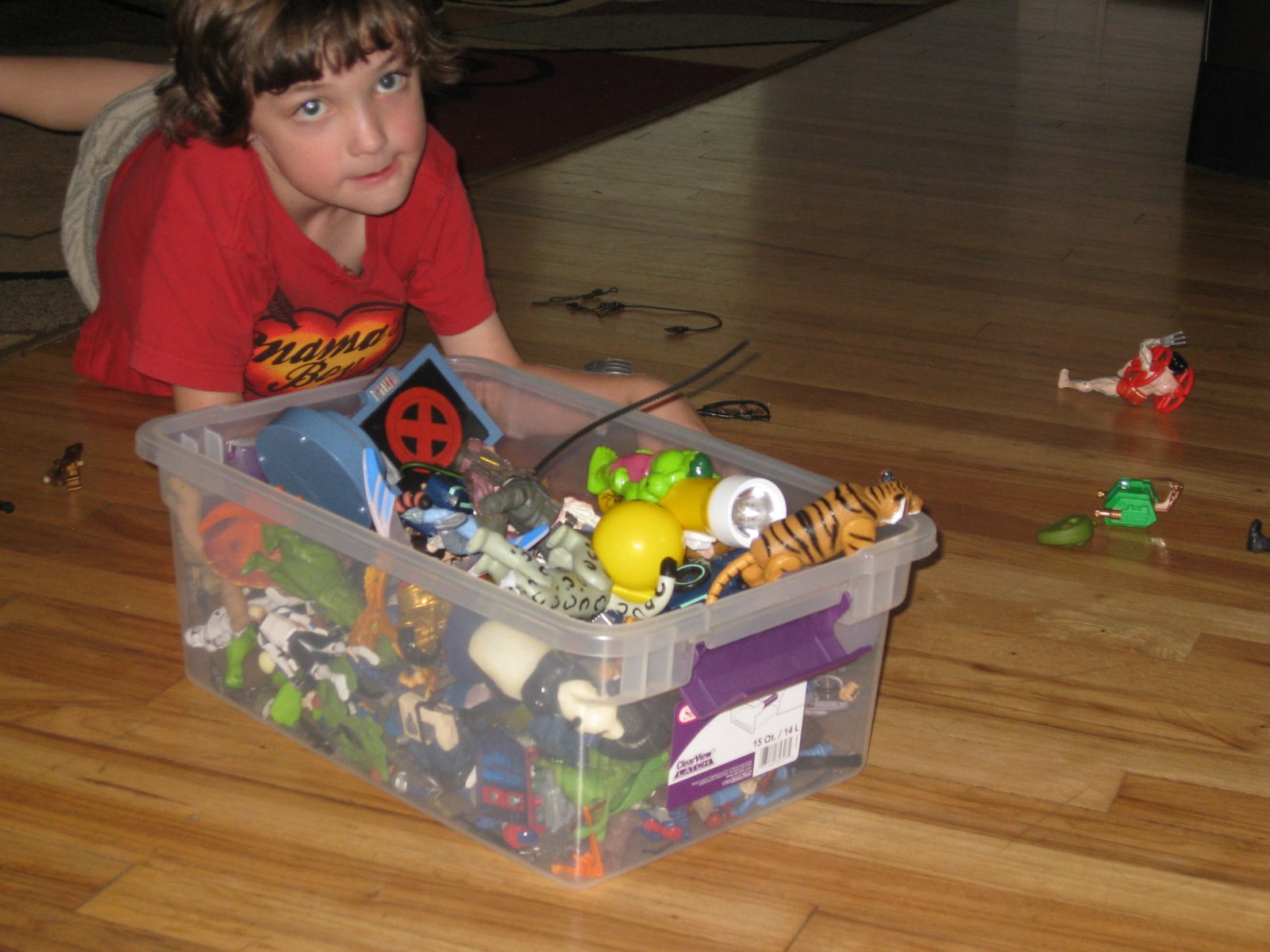
Today my sweet boy turns seven.... around this time every year we let go of the old stuff to make room for the toys that inevitably come with birthdays... this year was no different, except it was. Sunday Jack decided that he could let go of his playmobile guys. He has a fairly large collection including a big pirate ship; he has spent countless hours lost in worlds of his own creation and Sunday he decided he was too big for these little guys. My boy is growing up. I feel a little sad.
Since the collection represented not only a big time investment but a financial one as well. I decided to list it on a mommy listserv - within an hour some mom of littler boys had snapped it up. I told Jack he could have the money. Encouraged by the sale, the boy decided he could let go of his car collection, his musical instruments and his finger puppets. Anyway, he still has his vast empire of Legos, a huge collection of action figures and an enormous array of Yu-gi-oh cards. so I guess his imaged worlds are still going strong.
Which brings me to a bit of a professional crossover, I was reading an article by Bodrova and Leong about teaching kids make believe play. The authors point out that "back in the day" kids learned make believe play from each other in multi-age groups (read: running around with neighborhood kids) and today kids don't have those opportunities and so teachers need to help kids learn how to create elaborate play scenarios that can be extended and that allow children to truly "inhabit" their make believe worlds.
I sometimes worry about Jack learning all this since he is an only child, but as they described the highest stages of make believe play it seemed like they had been hanging out at our house on a typical afternoon. The planning and negotiating roles may take longer than the actual play and the child may act out the roles with imaginary partners. I have spent many an afternoon listening to Jack act out elaborate dueling scenarios with his Yu-gi-oh cards and an imagined opponent or talking to his Lego guys as they battle imagined enemies. I get a huge lift whenever I hear his voice change into his special make believe voice. I love that our life is slow enough that Jack has time to create and inhabit his make-believe worlds. Even now that he is seven.
What about you? What do you love seeing your kids do? When and where do they play make-believe?
Saturday, August 6, 2011
Finding the perfect pair of shoes in Cuba
In my closet, I have 21 pairs of shoes, but I have been thinking about getting a new pair of cowboy boots, which would bring the number up to 22. Here in Austin, I would guess that I am a bit below average as far as the size of my shoe collection.
This summer I had the opportunity to participate with three other women from Covenant and many from the church in Luyanó with their vacation Bible school; it was an incredibly challenging and rewarding experience. As I think about the trip, I am overwhelmed in all the amazing works God performed in Cuba; deciding on a story to share has been difficult
I considered writing about Georgina, who in spite of her arthritis, and other life challenges sews purses and tapestries for those at church, and presented me with an embroidered hand towel upon our first meeting. Or sweet Roy, a fifteen year old kid who, in spite of a difficult family life and a lack of financial resources shows up every time the church opens it doors and has been doing so, on his own since he was four years old. I could share about Sylvia, who in spite of a kitchen that most of us would completely gut if we were asked to cook in it daily, created delicious meals for us each day and accepted with great enthusiasm and gratitude the most basic kitchen materials we brought. Or maybe I should share the shear joy and delight of the children when presented with a bag of balloons. Or about Poopi and the other young adults who gave of their time and talents to help out with vacation Bible school and found the church to be a great place to hang out and talk. I could also share about seeing my Austin sisters-in-Christ give so selflessly of their time and talents. I could write about Rosita and Begonia who extended such hospitality to us, nourishing not just our bodies but our spirits as well? All of these people displayed God’s love and faithfulness to me while I was in Cuba.
But the shoes, I keep coming back to the shoes…. Of my 21 pair of shoes, I brought 3 pairs to Cuba – my super cool brand new Converse Chuck Taylor sneakers that I scored for a great deal at Marshalls at the beginning of the summer, a pair of flip-flops and another pair of shoes to wear at the beach. I wore the sneakers most of the week. As I said before, they are cool and comfortable, functional and fashionable. I love these shoes. On the last day of vacation Bible school, Poopi, who spoke English very well, brought his young cousin to me. Poopi explained that Franklin’s shoes needed to be repaired. He showed me the entire sole of the shoe had come loose and was barely hanging on. Poopi was confident that I could solve this problem. He mentioned glue, thinking perhaps I might have some. We had indeed brought a hot-glue gun and I thought this could solve the problem. I ran up to our room and got the glue gun. I sat down with Poopi and Franklin and got right to work. But the glue wouldn’t stick. The shoe was beyond repair. To be honest, if this was my shoe I would have immediately thrown it in the trash, put on another pair and gone out to get a new pair (and maybe two, if I found a sale.) Clearly, this was not an option for Franklin. Poopi explained that shoes are very expensive in Cuba and difficult to come by. I looked down; I noticed that my shoes were about the same size as Franklin’s. Another feature of these fabulous shoes is that they are just as cool for a 10-year-old boy as they are for a grown-up lady. I took off my shoes and Franklin tried them on. They were a perfect fit. The solution may seem fairly obvious – but these were my brand new shoes. My favorite shoes. My good for every occasion shoes. Poopi and Franklin were tentative, but I insisted. Franklin smiled. Pleased with his new shoes, he ran off to join his friends. Barefooted, I went to our room and grabbed my flip-flops. I wore my flip-flops for the rest of our trip. I gave away one pair of shoes – about $25 worth of manufactured goods. But the lesson was invaluable.
I often wonder how I can serve God. I think about how to best use my time, my talents and my resources. Before heading to Cuba, I pondered what God wanted me to do while I was there. I don’t speak Spanish. I am not a gifted singer or a compelling speaker. I am not particularly outgoing and I don’t dance or craft. I often wish I had more. More talent. More time. More money. More shoes. But in Cuba, I realized I have enough. More than enough, I have been richly blessed. I have plenty of shoes (and time and talents) – enough to share.
Saturday, July 2, 2011
Fight Gone Bad

Nathan convinced the whole family to do a crossfit work-out this morning. We were up and in the back yard doing, "Fight Gone Bad" training. 5 minutes of air squats - 1 minute rest - 5 minutes of jumping Jacks

1 minute of rest and ending with

5 minutes of dumb bell swings. Jack kept up the whole time and even did the macho man no shirt thing, just like his dad.
Saturday morning at 9:08 and I can check exercise off my list.

Science at home.

Jack and Nathan are figuring out a cool science experiment - a salt garden.

Here is the salt garden - about the only type of garden we seem to be able to keep growing.

Thursday, May 26, 2011
A new family in our neighborhood

Wednesday, May 25, 2011
Spending a day off



Monday, May 23, 2011
Taking a day off.

This weekend, I had the pleasure of celebrating graduation with several wonderful and intelligent folks. While at lunch, my former advisor mentioned that he had taken his daughters out of school for a fun day at town lake. Another professor, who may be one of the best reading teachers in the country suggested that he should have asked them to write a persuasive essay before agreeing to a day off from school, he countered that he didn't want to be "that dad". She persisted and suggested that each child write a list of ideas about how to spend the day.
She added that one of the biggest problems with most of the writing done in schools is that it isn't authentic. She added that children needed more meaningful writing opportunities were the purpose for writing was authentic. I was inspired. Today when Jack came home from school, I told him if he could write down 5 ideas about how to spend the day we could take a day off from school this week. Here is his list.
1. go to the pool
2. dool (duel- this is our favorite Yugi-oh card game).
3. go to tochees (Torchy's - a local taco place).
4. go to peese prc (go to Pease Park).
5. do art
6. slep late (sleep late)
7. go.... (Mom, can I just put those three dots to mean go to Target and get a luncheable?).
Saturday, May 21, 2011
library...
Jack and I visited the library today. The last few times we have been I can let Jack spend some time looking for books on his own - our usual strategy is that I find a few books which I think he might enjoy (that I will like reading to him), then I look at books for myself and he does some searching on his own (or looks at the computers they have there), then we meet and I read him the books we have found (or a chapter from a longer book) and he decides if he wants to check the book out. Today we found several great books.
Mrs. Frisby and the rats of NIMH by Robert O'brian - I remember my fourth grade teacher, Mrs. Benedict read this book to us. I think I check this book out of the library trying to read ahead and figure out what happened. This was a Newberry book back in 1971 - we'll see how it goes with Jack.
The extraordinary adventures of ordinary Basil by Wiley Miller - This book is the perfect mix of text and pictures and captured Jack's attention from the first sentence. So far this book is my pick for best book of the summer.
Addition by Sheila Cato - This was the book Jack found. This was the book Jack selected to read in the car on the way home from the library. It is filled with math facts and Jack was very impressed with my ability to answer several addition problems. 5+6+9 was the most difficult one - he thought it was hilarious when I suggested that the answer was 569 - this lead to a long and silly ride in the car.
Dinosaur vs. Bedtime by Bob Shea - I hate to include a spoiler but in spite of being victorious over adult conversation and leaf piles dinosaur does not defeat bedtime. Jack thought this book was great.
Peter Pan in Scarlet by Geraldine McCauhrean - Jack has been reading this book with his dad. It is pretty good, Jack like it enough to renew the book and finish reading it.
I also snuck these books into the stack while Jack wasn't looking.
Diego: Bigger than life by Carmen Bernier-Grand - a lovely book of poetry about Diego Rivera. I hope Jack will let me read some of the poems to him.
Built to last by David Macaulay - I love David Macaulay he is an amazing illustrator, I think this is his latest book. It shows how a castle, a cathedral and a mosque are built.
Naming Liberty by Jane Yolen - I love her writing another great story which I hope Jack will enjoy.
This is one of the books I put in for me:
Cheap: The high cost of discount culture by Ellen Shell- I have been interested lately in issues related to consumerism. I wonder and worry about how much stuff we have in our lives and how this impacts the quality of our life.
Thursday, May 5, 2011
Finishing strong
Today is my last class for the spring semester. I am finishing my first year as a teacher of teachers. I have enjoyed this year - but already I find myself thinking and planning about how to improve next time around.
I want to read more. I want to write more. I want to waste less time. I want to listen more and talk less. I want the time I spend with students to be meaningful and productive. I want the readings I assign to help students think about their practice and their philosophy of teaching.
Rather than feeling tired, I feel energized and excited about what lies ahead.
Tuesday, October 19, 2010
The last few days have been difficult here - but in the midst of the hard there have been some bright moments.
Yesterday Jack didn't have school and we had a bit of extra time in the morning. Jack came into our room and climbed into our bed between us and said, "Mommy let's be kitty cats." We used to be kitty cats, and pirate kitties all the time. He snuggled up next to me, making his kitty noises and said, "This is what kitties do when they need something." I snuggles in and make my kitty noises and said, "This is how kitty mommies say they are happy."
I love my little kitty.
Monday, December 28, 2009
Resolutions
I am big fan of starting the new year with newness. My birthday is January 3 and this year I am turning 40. So I am trying to make some resolutions. I have often read The Resolutions of Jonathan Edwards and been inspired/overwhelmed.
Being sensible that I am unable to do anything without God's help, I do humbly entreat him by his grace to enable me to keep these Resolutions, so far as they are agreeable to his will, for Christ's sake.
Remember to read over these Resolutions once a week.
1. Resolved, that I will do whatsoever I think to be most to God's glory, and my own good, profit and pleasure, in the whole of my duration, without any consideration of the time, whether now, or never so many myriad's of ages hence. Resolved to do whatever I think to be my duty and most for the good and advantage of mankind in general. Resolved to do this, whatever difficulties I meet with, how many and how great so ever.
That is 1 of 70. The 70th says " Let there be something of benevolence, in all that I speak."
While I do not propose to be as eloquent or as ambitious about my resolutions, I am hoping to adopt a few significant changes to my life. The first is a single word, Less -doing less, having less, spending less. All in the hopes of having more - more time, more freedom, more joy. The other change was gleaned from reading Calm my anxious heart, it is "Never complain about anything, not even the weather" (you can ask me about this in August).
Being sensible that I am unable to do anything without God's help, I do humbly entreat him by his grace to enable me to keep these Resolutions, so far as they are agreeable to his will, for Christ's sake.
Remember to read over these Resolutions once a week.
1. Resolved, that I will do whatsoever I think to be most to God's glory, and my own good, profit and pleasure, in the whole of my duration, without any consideration of the time, whether now, or never so many myriad's of ages hence. Resolved to do whatever I think to be my duty and most for the good and advantage of mankind in general. Resolved to do this, whatever difficulties I meet with, how many and how great so ever.
That is 1 of 70. The 70th says " Let there be something of benevolence, in all that I speak."
While I do not propose to be as eloquent or as ambitious about my resolutions, I am hoping to adopt a few significant changes to my life. The first is a single word, Less -doing less, having less, spending less. All in the hopes of having more - more time, more freedom, more joy. The other change was gleaned from reading Calm my anxious heart, it is "Never complain about anything, not even the weather" (you can ask me about this in August).
Thursday, October 22, 2009
Quality teaching
Quality teaching is one of my "scholarly" interests. My dissertation focused on quality teaching practices and I spent a fair amount of time defining “quality”
As a parent, I have had numerous conversations about finding the “best school” for my son when he starts kindergarten next fall - public v. private, transfer v. neighborhood, traditional v. Montessori, etc. Everyone wants their child to be in a high quality school.
I recently came across an interesting piece of research concerning classroom quality. I was interested in how they had defined quality, but I was also hoping to find some helpful information about identifying a good school for my son.
This research, conducted by Stuhlam & Pianta (2009) for the National Institute of Child Health and Human Development Early Child Care Research Network (NICHD ECCRN) observed and analyzed data from over 800 1st grade classrooms at over 700 different schools. The classrooms involved were varied demographically (socio-economic, ethnicity, public schools and private schools) and so were the teachers (years of experience, education, certification).
When assessing quality, each classroom was rated on both the affective nature (how supportive and positive the teacher was to a student's emotional needs) and the academic nature (the type of academic challenges and the type of feedback a teacher provided for her students). Sadly, only about 31% rated positively on both scales. 17% were rated with “overall low quality”. The rest of the classrooms were either ranked as being positive emotional climate with low academic quality or “mediocre”.
After the classrooms were rated the researchers compared the demographic data and made some interesting discoveries.
1) Students of color and those with lower family incomes were more likely to be in the lowest overall quality classrooms. Good news if you are white and middle class - not so much for everyone else.
2) Students with lower achievement scores in Pre-school were more likely to be in the lowest overall quality classrooms.
3) A teacher's education and her years of experience does not necessarily translate into a quality classroom environment.
4) Private schools do not necessarily provide higher quality classroom environments.
5) Teachers in the lowest quality classrooms were more likely to report feeling stressed, and facing significant challenges and barriers to success.
All of these findings have implications for parents and other stakeholders. But to me, the most interesting finding was that the main difference between the "high quality classrooms" and "positive emotional climate, lower academic demand classrooms" was the nature of the feedback that teachers gave to students.
6) Teachers in the high quality classrooms “frequently engaged students in conversations about their ideas, their work and their process of learning” (p. 332), while those in the other classrooms “rarely engaged students in discussions about the process of learning”.
No category existed for classrooms where the teacher engaged students academically but didn’t provide a positive emotional climate. Interesting?
In other words, you want your kid in a classroom where the teacher asks him questions and then listens to his answers and asks him more questions
It is strange to think that your socio-economic status and your ethnicity make your child more or less likely to have a quality classroom environment.
Tuesday, October 13, 2009
consistency
As blogging goes, I am not the most consistent person. I have tried on many occasions to make it a habit. Not something I do daily, just something I do on a regular basis.
Recently I have been struck with how many people achieve some professional note by making a promise to do something everyday and write about it on their blog (or other chosen venue).
For example, Julie and Julia, a lovely movie about two woman Julia Child and Julie Powell, started out as Julie's attempt to cook every recipe in Julia's Mastering the art of French Cooking in one year and blog about it. She got a book deal first, by the way.
Another new movie is a documentary about one man, who with his family attempts to erase his carbon footprint over the course of a year and blogs about his journey. He got a book deal out of it, as well.
On a smaller scale, I followed one blog for a while, as one woman cooked her family a crock pot meal everyday for 365 days. She got a guest spot on Rachel Ray and a book deal. She had some fantastic recipes.
Today, I was checking out the New York Times and found this. One woman decided to read a book a day a post a review on her blog. That is ambitious. She tried to limit her books to between 250-300 pages but still, that is a lot of reading. I wonder if she will get (or has) a book deal.
A.J. Jacobs has made the "my life as experiment" genre his life. He has written three books about 1)Reading the entire encyclopedia in a year, 2)Following all the commands in the Bible in a year and 3)a year spent testing out various lifestyles.
Okay.... I need a "life as experiment" type of experiment. One that no has not been done. One that might actually move me forward in my career and one that will get me a book deal.
Any ideas?
Recently I have been struck with how many people achieve some professional note by making a promise to do something everyday and write about it on their blog (or other chosen venue).
For example, Julie and Julia, a lovely movie about two woman Julia Child and Julie Powell, started out as Julie's attempt to cook every recipe in Julia's Mastering the art of French Cooking in one year and blog about it. She got a book deal first, by the way.
Another new movie is a documentary about one man, who with his family attempts to erase his carbon footprint over the course of a year and blogs about his journey. He got a book deal out of it, as well.
On a smaller scale, I followed one blog for a while, as one woman cooked her family a crock pot meal everyday for 365 days. She got a guest spot on Rachel Ray and a book deal. She had some fantastic recipes.
Today, I was checking out the New York Times and found this. One woman decided to read a book a day a post a review on her blog. That is ambitious. She tried to limit her books to between 250-300 pages but still, that is a lot of reading. I wonder if she will get (or has) a book deal.
A.J. Jacobs has made the "my life as experiment" genre his life. He has written three books about 1)Reading the entire encyclopedia in a year, 2)Following all the commands in the Bible in a year and 3)a year spent testing out various lifestyles.
Okay.... I need a "life as experiment" type of experiment. One that no has not been done. One that might actually move me forward in my career and one that will get me a book deal.
Any ideas?
Friday, October 9, 2009
Sick
Do you remember staying home from school when you were sick. It always seemed like a good deal when I was a kid. Laying on the couch Mom bringing me whatever I wanted, including special treats and watching all TV I wanted.
Sick isn't so good anymore.
The boy spent last week laying on the couch watching videos, getting all sorts of special treats. He had the flu. By Tuesday night he was feeling better but I had caught whatever he had and have been laying on the couch watching videos since. Today we had an unexpected twist, I got a call from the boy's school - He has pinkeye. The man is home from work and after wrestling the boy to the ground and enduring his screams while trying to put drops into eyes squeezed shut the two are playing video games, while I use an entire box of tissues, wishing I wasn't the mom.
I am sick of sickness.
Sick isn't so good anymore.
The boy spent last week laying on the couch watching videos, getting all sorts of special treats. He had the flu. By Tuesday night he was feeling better but I had caught whatever he had and have been laying on the couch watching videos since. Today we had an unexpected twist, I got a call from the boy's school - He has pinkeye. The man is home from work and after wrestling the boy to the ground and enduring his screams while trying to put drops into eyes squeezed shut the two are playing video games, while I use an entire box of tissues, wishing I wasn't the mom.
I am sick of sickness.
Friday, May 15, 2009
starting a fresh....
I have now finished my dissertation and am officially done with my career in graduate school.
I am hoping to use this space to share my plans, ideas and goals and integrating my professional life as an academic with my personal life as a wife and mother.
I am hoping to use this space to share my plans, ideas and goals and integrating my professional life as an academic with my personal life as a wife and mother.
Saturday, May 2, 2009
Just call me Dr. Feger
It is done. I defended the dissertation yesterday afternoon. It was scary and exciting. The committee talked about my work and the potential it has take the conversation about quality teaching and high-stakes testing in new directions.
I am so excited. I just need to finish my paper work and get the last signature.
I am so excited. I just need to finish my paper work and get the last signature.
Thursday, April 23, 2009
Differentiation and Dancing with the stars
Today in my class we talked about differentiating lessons. Several students were concerned about labeling students and the "tyranny of low expectations". I don't think I did a very good job explaining the concept. I ended the lesson early, feeling defeated.
When I got home I decided to watch Dancing with the Stars. I am just going to admit that I LOVE THIS SHOW. The premise of the show for those who have been locked up writing in a library. Is that professional dancers are paired with "celebrities" and each week the professionals teach their partner a new dance. The couples then perform the dance for a panel of judges, a live studio audience, and the viewers at home. The judges rate the dances on a scale of 1 to 10 and the audience votes for their favorite. Each week one couple gets eliminated.
As I was watching, it occurred to me that this show is an excellent example of differentiating instruction. Here's why...
First, each week the celebrity must learn a new skill (a different dance). The second, it that the job of the professional to design and teach the dance to the celebrity. Each dance must include certain elements (kicks, steps, etc), the judges look for these elements and others which are marks of good dancing in general (style, grace, musicality, etc.). At the end of each dance, there is an evaluation of the performance and the judges use the criteria to assign a score.
Of course, the metaphor doesn't always Reality television and education are very different. Besides the budget and the costumes, the most major difference is that on the show each week one contestant is eliminated and at the end there can only be one winner. Which is ironic, since the whole goal of differentiation is to facilitate success for everyone.
When I got home I decided to watch Dancing with the Stars. I am just going to admit that I LOVE THIS SHOW. The premise of the show for those who have been locked up writing in a library. Is that professional dancers are paired with "celebrities" and each week the professionals teach their partner a new dance. The couples then perform the dance for a panel of judges, a live studio audience, and the viewers at home. The judges rate the dances on a scale of 1 to 10 and the audience votes for their favorite. Each week one couple gets eliminated.
As I was watching, it occurred to me that this show is an excellent example of differentiating instruction. Here's why...
First, each week the celebrity must learn a new skill (a different dance). The second, it that the job of the professional to design and teach the dance to the celebrity. Each dance must include certain elements (kicks, steps, etc), the judges look for these elements and others which are marks of good dancing in general (style, grace, musicality, etc.). At the end of each dance, there is an evaluation of the performance and the judges use the criteria to assign a score.
Of course, the metaphor doesn't always Reality television and education are very different. Besides the budget and the costumes, the most major difference is that on the show each week one contestant is eliminated and at the end there can only be one winner. Which is ironic, since the whole goal of differentiation is to facilitate success for everyone.
Subscribe to:
Posts (Atom)